Paper and Power: Print Media in the Spartacus Uprising of 1919
News News blog
The Spartacus Uprising, also known as the January Battles, shook Berlin from January 5 to 12, 1919. During this turbulent period, paper in all its forms played a decisive role—from propaganda to documenting the conflict.
Paper as a Weapon of Propaganda
The battle for public opinion was largely fought on paper. As early as December 1918, the Anti-Bolshevik League distributed leaflets with the drastic demand: “Kill Liebknecht!” It offered rewards for the capture of the “ringleaders,” which served the same function as wanted posters. Even after the dismissal of Police President Emil Eichhorn on January 4, 1919—the trigger for the uprising—the warring parties continued to use printed messages. On January 8, the Council of People’s Representatives called for resistance against the insurgents in a leaflet titled “The Hour of Reckoning Approaches!” This also indirectly urged people not to follow the instructions of Eichhorn’s insurgent supporters. Rosa Luxemburg used the *Rote Fahne* (Red Flag) to spread her revolutionary ideas.
Printing Plants: Hubs of Conflict
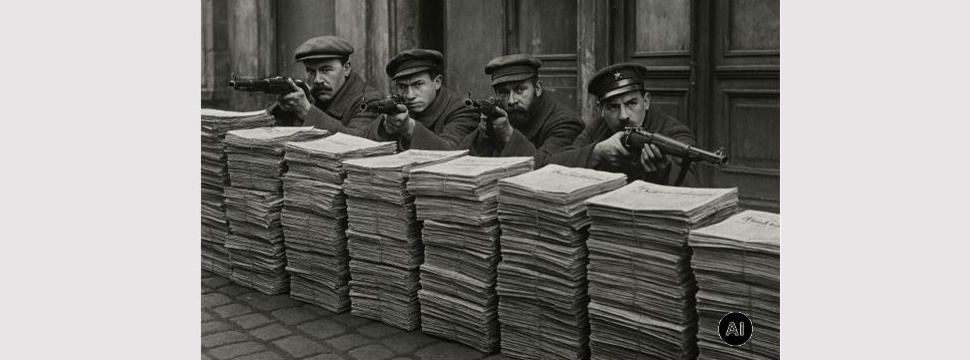
The strategic importance of paper was also evident in the occupation of key printing plants and publishing buildings. During the demonstration on January 5, armed men occupied key locations in Berlin’s newspaper district. These included the printing plants of the Social Democratic “Vorwärts” and the “Berliner Tageblatt,” as well as the publishing houses of Scherl, Ullstein, and Mosse, the Büxenstein printing plant, and the Wolff Telegraph Office. These locations were not only production facilities but also warehouses for huge quantities of newspaper rolls and stacks, which formed the infrastructure of the occupied buildings. Control over these printing centers was crucial for spreading their own message and suppressing that of their opponents. The Spartacists used the stacks of newspapers not only as a strategic resource but also as improvised barricades behind which they sought shelter or camouflage.
Arrest Warrants and Documentation
After the bloody suppression of the uprising, the government sought out the alleged coup plotters to prosecute them for the attempted coup. The corresponding arrest warrants—written orders for arrest—served as the legal basis for this. The subsequent legal proceedings, such as the field court-martial against those involved in the murders of Rosa Luxemburg and Karl Liebknecht, were also documented in writing. The Berlin press played a key role in shaping the narrative of these events by publishing reports on the murders based on official documents.
The Spartacus Uprising vividly illustrates how paper and print media, as vehicles for information, propaganda, and legal documents, can influence the fate of a nation during times of political upheaval.