New Euro Banknotes: Have Your Say on the Design of the Future
News News blog
The euro banknotes are getting a fresh new look—and you can have your say! The European Central Bank (ECB) has unveiled ten innovative design concepts for the new euro banknotes and is inviting all citizens to vote online. Until September 21, 2026, you can choose your favorite and actively help shape the future of our cash.
Why are the euro banknotes getting a new design?
More than two decades after the euro’s introduction in 2002, it’s time for a modernization. The current banknotes feature abstract bridges and gates—a deliberately neutral design intended to avoid favoring any one country when the euro was introduced. But times have changed.
The new euro banknotes serve several important purposes:
- Strengthening European identity: The new designs are intended to make the shared identity of EU member states more tangible. ECB President Christine
- Lagarde emphasizes: “Euro banknotes are more than just a means of payment—they are one of the most tangible expressions of Europe.”
- Enhanced security features: Modern anti-counterfeiting technologies make it harder for criminals to operate and protect consumers from counterfeit money.
- Sustainability and durability: The new banknotes are produced in a more environmentally friendly way and last longer.
- Accessibility: People with visual impairments will be able to distinguish between the different denominations more easily in the future.
Two design themes to choose from
The basic selection of designs has already been finalized—here, too, EU citizens were able to express their opinions in a preliminary survey. Two themes emerged as the clear favorites:
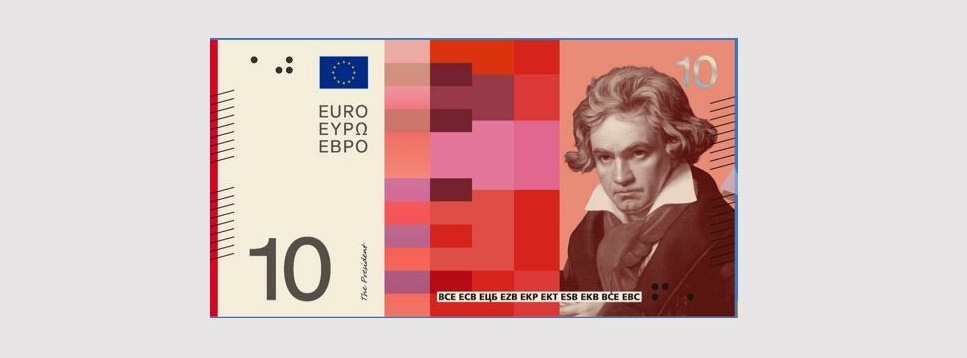
European Culture—Figures Who Shaped Europe
This design series features significant figures from European cultural history:
• 5-euro note: Maria Callas (singer)
• 10-euro note: Ludwig van Beethoven (composer)
• 20-euro note: Marie Curie (scientist)
• 50-euro note: Miguel de Cervantes (writer)
• 100-euro bill: Leonardo da Vinci (artist)
• 200-euro bill: Bertha von Suttner (writer, Nobel Peace Prize laureate)
The reverse sides depict vibrant cultural scenes such as street art, a children’s choir, or libraries.
Rivers and Birds – Europe’s Natural Diversity
The second series of designs focuses on European nature:
• 5-euro note: Wallcreeper
• 10-euro note: Kingfisher
• 20-euro note: Flock of bee-eaters
• 50-euro note: White stork
• 100-euro note: Avocet
• 200-euro note: Northern Gannet
The reverse sides feature important EU buildings such as the European Parliament, the European Commission, and the ECB.
Ten Design Concepts – Your Vote Counts!
From an EU-wide design competition with over 1,200 entries, the ECB has selected ten final designs. Now it’s your turn: Which design do you like best?
The ten selected graphic designers have creatively interpreted the given motifs—ranging from classically elegant to modern and abstract. Each design offers its own visual language and approach.
How to Vote
Participating is very simple:
1. Visit the ECB’s official voting page
2. Click through all ten design proposals
3. Rate each design based on your personal preference
4. Optionally, explain what you like or don’t like
Voting period: You can cast your vote until September 21, 2026.
How much say do citizens really have?
Citizen participation is an important part of the decision-making process—but not the only one. Here’s how the process works:
- Phase 1 (completed): EU citizens voted in a survey to choose among different design themes. “European Culture” and “Rivers and Birds” emerged as the winners.
- Phase 2 (current): The ongoing vote on the ten design proposals. Your vote is factored into the evaluation.
- Phase 3 (end of 2026): The Governing Council of the ECB makes the final decision. In doing so, the Council takes citizens’ opinions into account, as well as technical aspects such as counterfeit-resistance, production costs, and accessibility.
Public participation is therefore an important factor, but the final decision rests with the Governing Council of the ECB. Your voice will be heard and carries weight—those responsible want a design that is accepted and appreciated by the public.
When will the new euro banknotes enter circulation?
Once the design decision is made in late 2026, the technical implementation will begin. The new banknotes will not be put into circulation for several years—an exact date has not yet been set. Producing modern banknotes with highly complex security features takes time.
The old euro banknotes will, of course, remain valid and will be gradually phased out of circulation.
Cash Remains Important—Despite Digitalization
Many people worry that cash might disappear in the long run. In fact, according to a study by the Cologne-based retail research institute EHI, Germans already make 65 percent of their purchases digitally using cards or smartphones—with only 33 percent paid for with bills and coins.
However, the ECB makes it clear: Cash is here to stay! Even the planned digital euro is intended only to complement cash, not replace it. The current legislative package on the digital euro even mandates that both cash and the digital euro must be accepted.
The redesign of banknotes sends a clear signal: The ECB is investing in the future of cash and takes the wishes of citizens seriously.