Edible Pictures and Edible Prayers: Religious Folk Medicine of Past Centuries
News News blog
Edible pictures and edible prayers were part of religious folk medicine for centuries. These small paper notes were meant to bring healing to the sick through swallowing. Today they are almost forgotten, but their history shows us fascinating insights into the faith of past eras.
What are Edible Pictures and Edible Prayers?
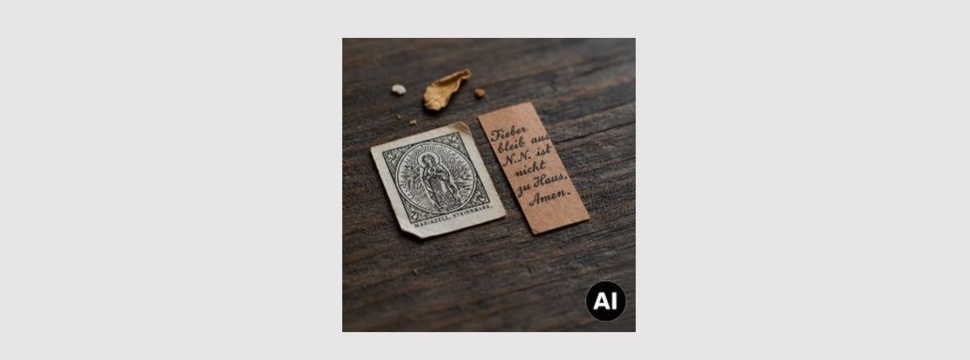
Edible pictures are small notes with religious imagery that believers used from the 17th to 20th centuries as a "spiritual home pharmacy." The tiny pictures usually measured only 5 to 20 mm and mainly showed the Virgin Mary or other saints.
Edible prayers, on the other hand, carried no images but only text: prayers, saints' names, Bible verses, or meaningful sayings. Sometimes red paper was used for special effect. In Holstein, for example, fever patients were given a slip with the inscription "Fever stay away / N.N. is not at home."
Production and Sale of the Sacred Little Notes
Production was done industrially on whole sheets arranged like stamps. Some sheets contained over 130 edible pictures. Well-known manufacturers were F. Gutwein from Augsburg, J. M. Söckler from Munich, and Frères Benziger from Einsiedeln.
The little notes were sold mainly at pilgrimage sites by merchants, but also by quacks. In 1898, a "quack doctor" in Saxony sold his sympathy slips for 0.30 to 1 Mark. Even some monasteries operated a flourishing business with these religious remedies.
Application as "Paper Pills"
The application was simple: the little notes were soaked in water, dissolved, or mixed into food and then swallowed by the patient. People spoke of the "paper pill" or "gratia medicinalis."
Not only humans but also animals received this treatment. Livestock were given mainly "fire slips" against anthrax. For rabies, people trusted in the effectiveness of the Sator formula.
Distribution in Europe and Beyond
Edible pictures and edible prayers were widespread throughout Europe. In Protestant regions like Württemberg, East Frisia, or Hamburg, patients were made to symbolically "eat up" their illness by writing names or birth dates on slips and putting them in bread or fruit.
Interesting: Similar practices were found outside Europe as well. In eastern Mongolia, Tibetan magic formulas were used on small slips. In Uganda, at the end of the 1990s, followers of a miracle healer drank water in which they had soaked his photograph.
The End of a Tradition
As late as the early 1970s, edible pictures were sold in Mariazell, Naples, and Florence. Today this form of folk medicine has practically disappeared. The Roman Congregation for the Doctrine of the Faith had declared in 1903 that there was nothing wrong with their use "provided superstition is excluded."
Edible pictures and edible prayers show us how deeply religious faith and the search for healing were intertwined. They are witnesses to a time when the boundaries between medicine and spirituality were fluid.